Trakošćan
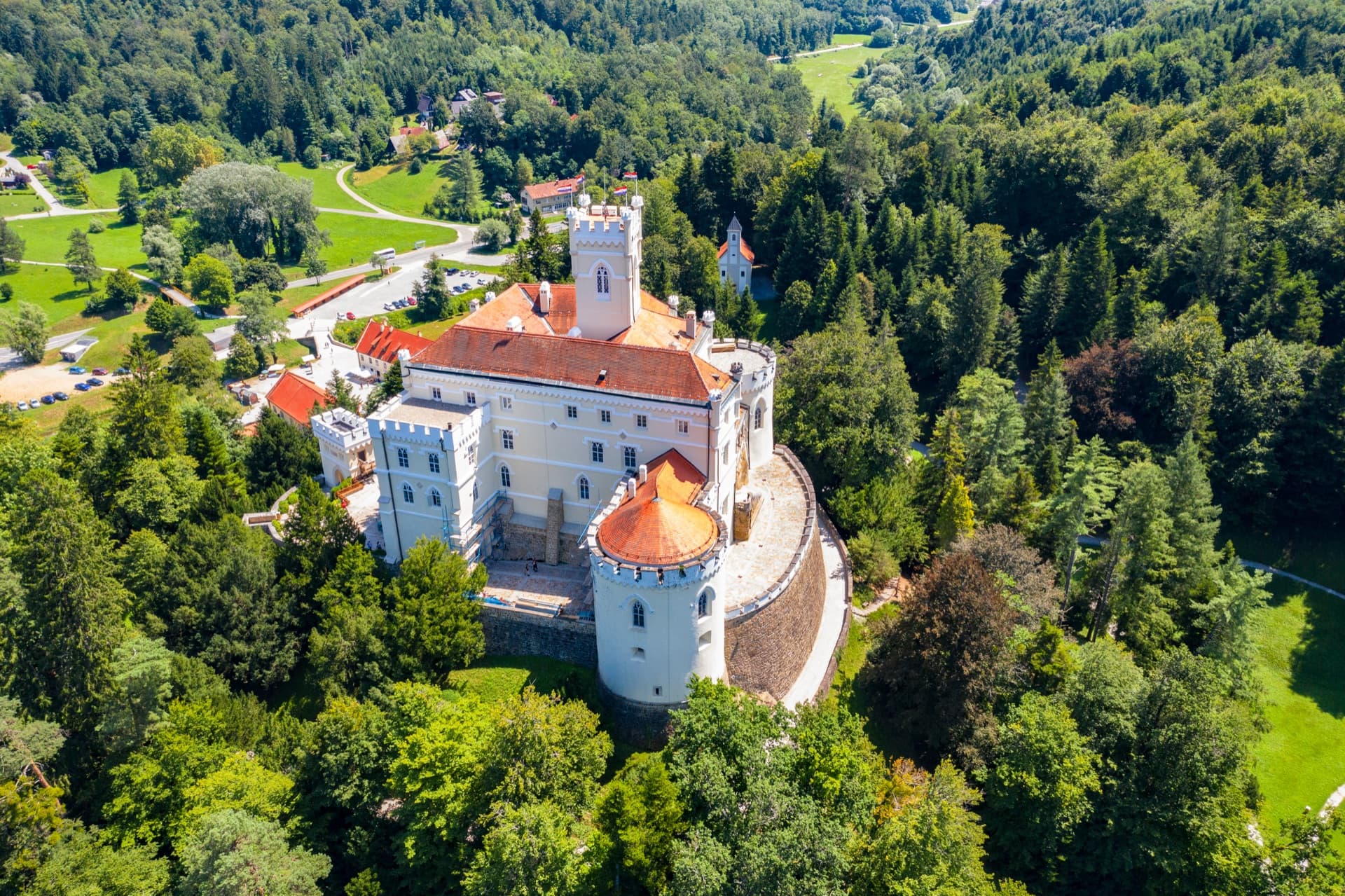
Croatia's most photographed castle — a white Romanticist fortress above a lake in the Zagorje hills, with a well-preserved interior and good walking around the water
About Trakošćan
Trakošćan is a medieval castle on a wooded hill in the Zagorje region, about 90 kilometres north of Zagreb near the town of Lepoglava. The present appearance is largely a 19th-century creation: the Drašković family, who owned the castle from the 16th century, commissioned a comprehensive Romanticist rebuild in the 1840s and 1850s under the direction of Ludwig von Zahn, transforming a strategic fortress into a residential palace in the fashionable Gothic Revival style of the period. An artificial lake was created below the castle at the same time. The result is one of the most scenic castle settings in Central Europe, and the image of the white towers reflected in the lake below has become one of Croatia's most reproduced photographs.
The interior of the castle functions as a museum. The collection includes weapons, armour, portraits of the Drašković family, period furniture, and memorabilia from the 19th century. The standard of preservation is high. The castle is easy to combine with Varaždin as a Zagorje day trip, or with Krapina and Kumrovec for a broader inland Croatia circuit.
What to See & Do
Trakošćan Castle and Museum
The castle interior is the main attraction: rooms preserved in their 19th-century state, the Drašković family collection, weapons and armour, and good views from the upper floors and the castle terrace. The building itself is impressive from every angle. Allow 1 to 1.5 hours inside. Open daily except Christmas Day and Easter Sunday. April–October: 9:00–18:00 (last entry 17:30). November–March: 9:00–16:00 (last entry 15:30). Adults €10, under-26 and over-65 €7, students and disabled visitors €5, family ticket €25. Children under 7 enter free with a parent.
Trakošćan Lake Walk
An artificial lake sits in the valley below the castle, surrounded by walking paths through woodland. The lakeside walk is one of the most pleasant easy walks in inland Croatia — flat, quiet, with constant views of the castle above. The full circuit takes about 45 minutes to an hour. Note that a section of the lakeside path is currently closed because of a landslide; the lake remains accessible via the open sections and posted signage. The reflection of the castle in the water is the classic Trakošćan photograph.
Key Highlights
- Trakošćan Castle — 19th-century Romanticist rebuild with well-preserved interior
- Castle museum: Drašković family collection, weapons, period furniture
- Artificial lake with lakeside walking paths
- One of Croatia's most recognisable castle landscapes
- 90km from Zagreb
- Easily combined with Varaždin
How to Get There
By car, Trakošćan is about 80 km from Zagreb and roughly 40 km from Varaždin. From Zagreb, use the A2 toward Krapina and follow signs to Trakošćan. There is no direct bus from Zagreb to Trakošćan; public transport usually requires travelling via Varaždin and then using a local connection. For most visitors, a car is the practical option.
When to Visit
Trakošćan can be visited year-round, but spring and autumn are the most rewarding. The wooded hillside changes colour dramatically in October, and the lake walk is pleasant in spring when the surrounding trees are in leaf. Summer is busiest. Winter is possible, but some facilities may be limited.
Frequently Asked Questions about Trakošćan
Both. The exterior and lakeside setting justify the visit on their own, but the interior is genuinely well preserved and the Drašković family collection is more interesting than a typical regional museum. Plan for both.
Yes, easily. Trakošćan is about 40km west of Varaždin, so the two work naturally as a day circuit — castle in the morning, Baroque city in the afternoon.
Explore More Destinations in Croatia
Varaždin
Croatia's Baroque jewel with elegant palaces, manicured parks, and world-class music festivals.
Krapina
Home to one of the world's most significant Neanderthal fossil sites and an excellent science museum.
Kumrovec
Tito's birthplace and home to Staro Selo — one of Croatia's best open-air ethnographic museums.